


Your shopping cart is empty!
Bean climbing "Sunset"

Eco seeds
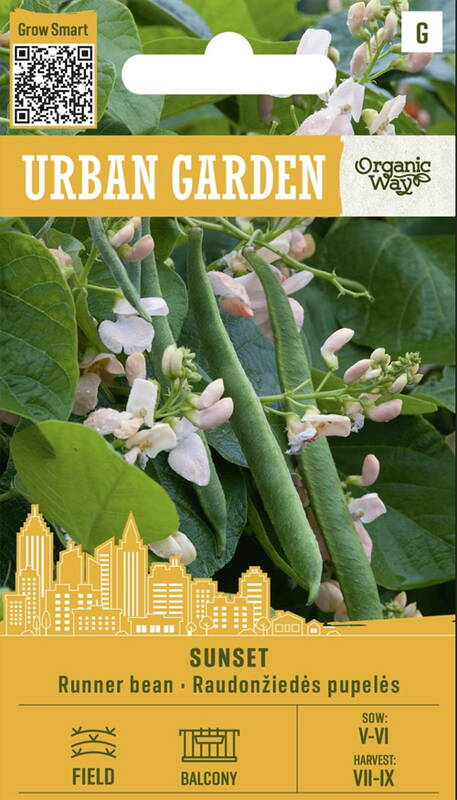
Phaseolus vulgaris var. vulgaris.
1.42€
Ex Tax: 1.14€
Ex Tax: 1.14€
Climbing Bean "Sunset".
Not only tasty but also very decorative!
A variety of climbing bean with a long fruiting period. The harvest is collected 100 days after sowing. The plants are very decorative, blooming with peach-coloured flowers, reaching a height of 4 m, and therefore require sturdy support. The seeds are pink with black dots and stripes, possessing an excellent taste.
In the natural pursuit of beauty and flavour, do not forget the main feature of the climbing bean — its dislike of the cold: it fears both late spring frosts and the first ones of autumn. Therefore, gardeners in our temperate-cool climatic zone should prefer early and mid-ripening varieties or grow climbing beans through seedlings. Otherwise, you simply won't have time to get a decent harvest, no matter how productive and decorative the variety might be.
1,0 g = 0,5-1 seed.
OBTAINING YOUR OWN BEAN SEEDS.
To obtain mature seeds, the pods are left on the plant until they acquire a golden-brown colour. Then the stems are carefully cut and hung to dry under a canopy. Dried pods are shelled, and the seeds are dried for several days. Store in containers with a tightly fitting lid in a dark, cold place.
PRE-SOWING SEED PREPARATION.
Bean seeds, like those of other crops, must be prepared for sowing. Select healthy seeds without mechanical damage. It is very good to soak bean seeds in a solution of microelements.
Seeds can be germinated before sowing. To do this, they are placed between two layers of moist cloth. As it dries, the cloth is re-moistened. The sprouts must be small so as not to break during sowing. When sowing with sprouted seeds, keep in mind that seedlings will appear earlier and need to be protected from frosts, to which they are very sensitive. Therefore, sprouted seeds are sown when the soil at the planting depth warms up to +11+12°C and the threat of frost has passed. Beans can also be grown at earlier dates using temporary film shelters and taking measures to protect plants from frost.
CULTIVATION OF BEANS.
The best soils for beans are light, fertile, light loamy and sandy loam soils with low groundwater levels, which warm up well. It does not tolerate acidic, waterlogged soils!
Soil with a pH of less than 4.0 is considered acidic. Externally, acidity manifests itself in the formation of a light green coating on the soil surface, but a site located in the shade can also turn green.
How to determine soil acidity? With the help of plants.
On neutral soil grow: nettle, quinoa, chickweed, shepherd's purse.
On slightly acidic: couch grass, coltsfoot, dandelion, chamomile, clover, fern.
On alkaline: poppy, bindweed.
On acidic: plantain, wild mint, wild sorrel.
The best predecessors for beans are considered all types of cabbage, pumpkin crops, early potatoes, and vegetable root crops. It should not be grown after previous legumes and sunflowers. It is recommended to return it to the same place after 4-5 years.
The soil for beans needs to be prepared in the autumn. It is better if organic fertilizers were applied under the crop preceding the beans. If this was not done, then in the autumn, 4 kg/m² of compost or 2-4 kg/m² of rotted manure, as well as mineral fertilizers: 25-30 g/m² of superphosphate and 12-15 g/m² of potash fertilizers, are applied under digging to a full spade bayonet depth. If necessary, the soil is limed (if pH is less than 5.5, and liming was not carried out under the preceding crop) — 200-600 g/m² of lime depending on soil acidity. In the spring, it is necessary to apply 10-15 g/m² of ammonium nitrate; wood ash can also be added during loosening. Remember that beans are very responsive to potash fertilizers: with a lack of potassium, leaves turn yellow, and plants become susceptible to diseases.
The best time for sowing bean seeds is the second or third decade of May to the first days of June. Usually sown in two terms: early, when the soil at a depth of 10 cm warms up to +11+12°C, and 7-10 days later. If the beans are to be used for green pods (scapula), then they can be sown up to 4 times with an interval of one and a half weeks. To extend the period of obtaining pods in autumn, temporary film shelters are installed over the plants in mid-September.
Sowing can be done in several ways: in rows, with spacing of 30-40 cm and a distance between plants of 10-12 cm; and two-line ribbon sowing with a distance between ribbons of 60 cm, and between rows of 25 cm with the same distance between plants.
Seeds are embedded to a depth of 3-5 cm depending on the mechanical composition of the soil. On light, well-warmed soils, beans are sown on a flat surface, and on cold ones (with high groundwater standing) — on ridges.
Bean plantings require regular soil loosening to a depth of up to 6 cm. Be sure to loosen the soil after watering, feeding, and heavy rains. Ensure that weeds do not grow back.
Beans require regular watering, especially during flowering and pod formation. Water up to twice a week. Watering is combined with feeding, which is done at the root of the plant. In no case should fertilizers fall on the leaves, which causes burns that even subsequent watering does not save from. Feeding is carried out in the budding phase at the rate of 15 g/m² of superphosphate and 5 g/m² of potassium chloride.
Bean plants need to be tied to stakes, and for climbing varieties, tall poles are installed.
Not only tasty but also very decorative!
A variety of climbing bean with a long fruiting period. The harvest is collected 100 days after sowing. The plants are very decorative, blooming with peach-coloured flowers, reaching a height of 4 m, and therefore require sturdy support. The seeds are pink with black dots and stripes, possessing an excellent taste.
In the natural pursuit of beauty and flavour, do not forget the main feature of the climbing bean — its dislike of the cold: it fears both late spring frosts and the first ones of autumn. Therefore, gardeners in our temperate-cool climatic zone should prefer early and mid-ripening varieties or grow climbing beans through seedlings. Otherwise, you simply won't have time to get a decent harvest, no matter how productive and decorative the variety might be.
1,0 g = 0,5-1 seed.
OBTAINING YOUR OWN BEAN SEEDS.
To obtain mature seeds, the pods are left on the plant until they acquire a golden-brown colour. Then the stems are carefully cut and hung to dry under a canopy. Dried pods are shelled, and the seeds are dried for several days. Store in containers with a tightly fitting lid in a dark, cold place.
PRE-SOWING SEED PREPARATION.
Bean seeds, like those of other crops, must be prepared for sowing. Select healthy seeds without mechanical damage. It is very good to soak bean seeds in a solution of microelements.
Seeds can be germinated before sowing. To do this, they are placed between two layers of moist cloth. As it dries, the cloth is re-moistened. The sprouts must be small so as not to break during sowing. When sowing with sprouted seeds, keep in mind that seedlings will appear earlier and need to be protected from frosts, to which they are very sensitive. Therefore, sprouted seeds are sown when the soil at the planting depth warms up to +11+12°C and the threat of frost has passed. Beans can also be grown at earlier dates using temporary film shelters and taking measures to protect plants from frost.
CULTIVATION OF BEANS.
The best soils for beans are light, fertile, light loamy and sandy loam soils with low groundwater levels, which warm up well. It does not tolerate acidic, waterlogged soils!
Soil with a pH of less than 4.0 is considered acidic. Externally, acidity manifests itself in the formation of a light green coating on the soil surface, but a site located in the shade can also turn green.
How to determine soil acidity? With the help of plants.
On neutral soil grow: nettle, quinoa, chickweed, shepherd's purse.
On slightly acidic: couch grass, coltsfoot, dandelion, chamomile, clover, fern.
On alkaline: poppy, bindweed.
On acidic: plantain, wild mint, wild sorrel.
The best predecessors for beans are considered all types of cabbage, pumpkin crops, early potatoes, and vegetable root crops. It should not be grown after previous legumes and sunflowers. It is recommended to return it to the same place after 4-5 years.
The soil for beans needs to be prepared in the autumn. It is better if organic fertilizers were applied under the crop preceding the beans. If this was not done, then in the autumn, 4 kg/m² of compost or 2-4 kg/m² of rotted manure, as well as mineral fertilizers: 25-30 g/m² of superphosphate and 12-15 g/m² of potash fertilizers, are applied under digging to a full spade bayonet depth. If necessary, the soil is limed (if pH is less than 5.5, and liming was not carried out under the preceding crop) — 200-600 g/m² of lime depending on soil acidity. In the spring, it is necessary to apply 10-15 g/m² of ammonium nitrate; wood ash can also be added during loosening. Remember that beans are very responsive to potash fertilizers: with a lack of potassium, leaves turn yellow, and plants become susceptible to diseases.
The best time for sowing bean seeds is the second or third decade of May to the first days of June. Usually sown in two terms: early, when the soil at a depth of 10 cm warms up to +11+12°C, and 7-10 days later. If the beans are to be used for green pods (scapula), then they can be sown up to 4 times with an interval of one and a half weeks. To extend the period of obtaining pods in autumn, temporary film shelters are installed over the plants in mid-September.
Sowing can be done in several ways: in rows, with spacing of 30-40 cm and a distance between plants of 10-12 cm; and two-line ribbon sowing with a distance between ribbons of 60 cm, and between rows of 25 cm with the same distance between plants.
Seeds are embedded to a depth of 3-5 cm depending on the mechanical composition of the soil. On light, well-warmed soils, beans are sown on a flat surface, and on cold ones (with high groundwater standing) — on ridges.
Bean plantings require regular soil loosening to a depth of up to 6 cm. Be sure to loosen the soil after watering, feeding, and heavy rains. Ensure that weeds do not grow back.
Beans require regular watering, especially during flowering and pod formation. Water up to twice a week. Watering is combined with feeding, which is done at the root of the plant. In no case should fertilizers fall on the leaves, which causes burns that even subsequent watering does not save from. Feeding is carried out in the budding phase at the rate of 15 g/m² of superphosphate and 5 g/m² of potassium chloride.
Bean plants need to be tied to stakes, and for climbing varieties, tall poles are installed.
* The homeland of the common bean is considered to be South America.
Indians have used beans for food since ancient times. It was brought to Europe by the sailors of Christopher Columbus.
On the coast of Cuba, a memorial plaque is installed with the inscription: «On October 28, 1492, Christopher Columbus landed at this place».
He and his sailors saw endless fields of string beans, which they took with them. Thus, the bean came to the Eurasian continent.
CULTURAL VALUE.
Bean seeds and their green pods are food products that contain almost all the essential substances necessary for normal human nutrition.
In terms of protein content, seeds approach meat and exceed fish. By their composition, bean proteins are close to meat proteins and are 75% absorbed by the body with ordinary cooking methods.
In addition to proteins, carbohydrates (mono- and oligosaccharides, starch), nitrogenous substances (including essential amino acids), flavonoids, sterols, and organic acids have been found in the fruits.
Beans contain a rich set of vitamins: pyridoxine, thiamine, pantothenic, nicotinic, and ascorbic acids. Isoflavonoids and coumestans were found in common and mung beans. Flavonols, leucoanthocyanins, and anthocyanins have been found and identified in the aerial part of the bean.
Beans are used in medicine: agglutinins have been discovered in them — substances that accumulate in human blood during infectious diseases and cause the clumping and precipitation of pathogenic microbes and other cellular elements. In other words, these elements play a large role in human immunity (resistance) to certain infectious diseases.
Bean extracts significantly lower blood sugar levels, so beans are used for diabetes mellitus. A decoction of bean pods is used for rheumatism and as a diuretic for oedema of renal origin or due to heart failure.
Beans are useful for kidney diseases. Bean pods are included in herbal mixtures recommended for the treatment of gout, urolithiasis, and cystitis. A decoction of bean pods and blueberry leaves (in equal parts) is recommended for pancreatic disease. An essence from the whole plant, collected after the fruits ripen, is used in homeopathy.
Among leguminous crops, beans are second only to soybeans in world sown areas. The nutritional value of beans is due not only to the high content of highly digestible protein but also to its amino acid composition, which is at the level of meat and milk proteins in terms of the set and quantity of essential amino acids. For this reason, beans are often called "vegetable meat", since they can replace it in human nutrition and fully satisfy the body's need for nitrogen. Mature seeds and fresh green pods are eaten. Dry bean grains are used in the preparation of first courses — soups, borsch.
Pates, sauces, and various salads are prepared from boiled vegetable beans. Boiled bean seeds together with rice, onions, carrots, and various spices are a good filling for stuffed cabbage rolls.
Flour with a high protein content is obtained from seeds of predominantly white-seeded bean varieties. White bean flour looks like wheat flour, but it is not used in its pure form in baking because the dough from it rises poorly and is difficult to bake through. This flour is usually added to wheat flour to increase the nutritional qualities of white bread and bakery products. Such bread is especially useful for children.
Bean flour is added to wheat flour in the production of certain types of pasta, which significantly increases their nutritional value. In the North Caucasus, bean flour is often mixed with corn flour.
Mature bean grains are also used to make highly nutritious meat-and-vegetable canned food. High-quality dry briquettes are prepared from dry bean seeds. Immature bean seeds are canned like green peas. One of the promising ways to preserve beans is freezing. Freshly shelled bean seeds are sometimes used in nutrition, from which soups, vinaigrettes, salads, and side dishes for main courses are cooked.
In raw form, neither seeds nor pods are recommended for consumption because they contain the poisonous glycoside phaseolunatin, which can cause poisoning. However, after heat treatment, phaseolunatin is destroyed and no longer poses a danger.